
Few and defined
Government is not a service organization

I have been meaning to write on this topic for a while, and finally, due to a “conversation” on X, I’m compelled to do so.
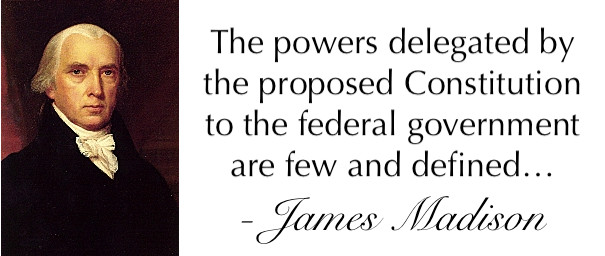
Something that has plagued America at least since the Progressive Era is federal government involvement in social issues and providing of “services.” The founders never expected nor intended the federal government to be a service organization. On the contrary, the powers and responsibilities of the federal government are, as Madison wrote in the Federalist No. 45, “few and defined”:
The powers delegated by the proposed constitution to the federal government, are few and defined. Those which are to remain in the state governments are numerous and indefinite. The former will be exercised principally on external objects, as war, peace, negociation, and foreign commerce; with which last the power of taxation will for the most part be connected. The powers reserved to the several states will extend to all the objects, which, in the ordinary course of affairs, concern the lives, liberties and properties of the people; and the internal order, improvement and prosperity of the state.
The Federalist No. 45 - James Madison
Madison’s assertion is that the responsibilities of the federal government are primarily aimed at handling foreign relations and national defense, and that it is to be only very minimally involved in domestic matters.
Which brings me back to my discussion on X and the arguments/statements made by the other person, who, in her lack of understanding of our founding documents and principles, was rather adamant and vitriolic in asserting not only that the government should be providing services, but that, just because the Constitution doesn’t mention something doesn’t mean the government can’t or shouldn’t do it.
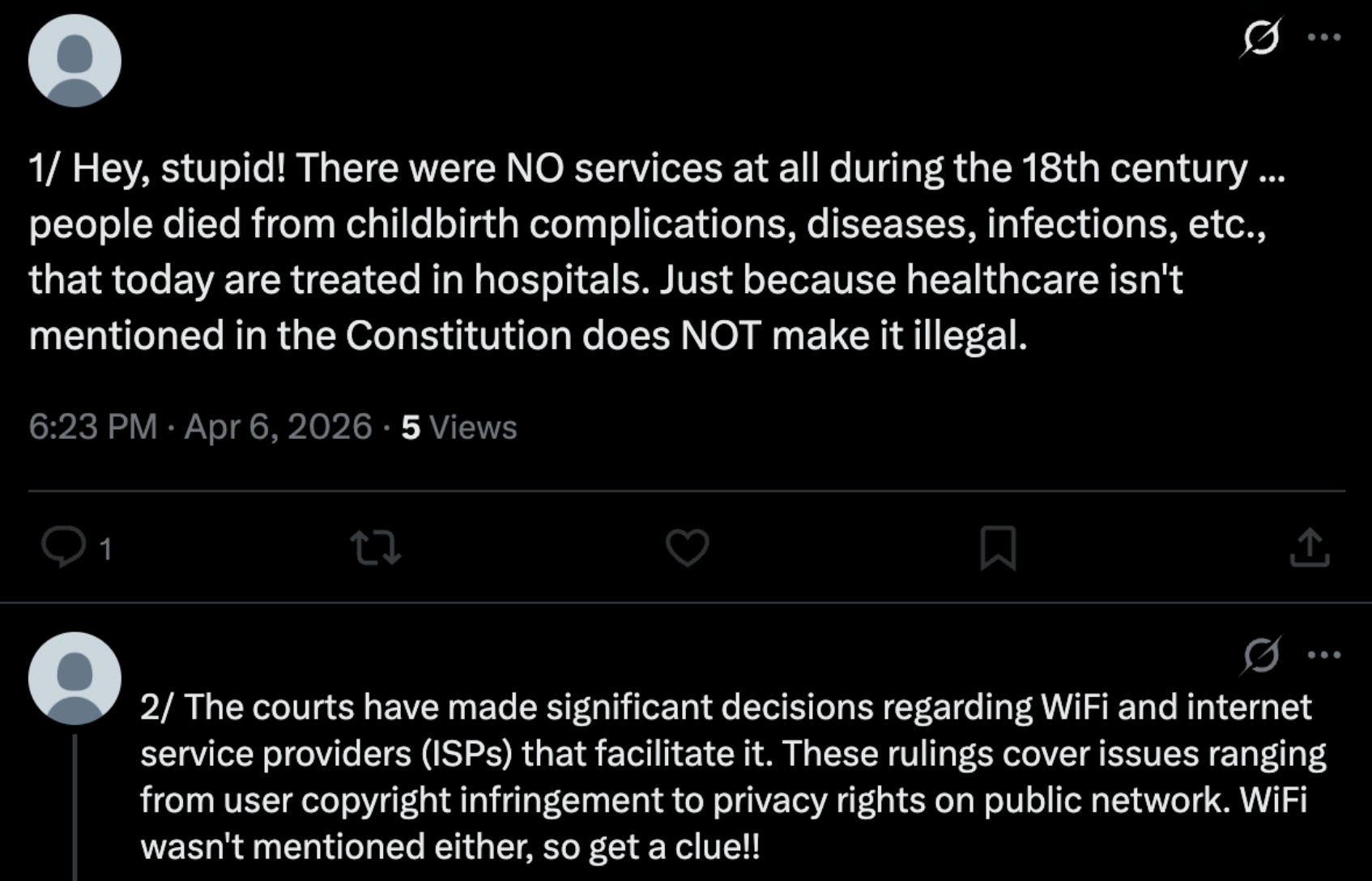
But that is precisely Madison’s point in what he penned. “Few and defined” means that there are not many and that they are specific, not implied. Even so, this person, who is fairly representative of the majority of the American population, believes otherwise. The fact that the Tenth Amendment reinforces the limitation of the federal government to that which is stated in the Constitution, that “The powers not delegated to the United States by the Constitution, nor prohibited by it to the States, are reserved to the States respectively, or to the people,” she persisted.
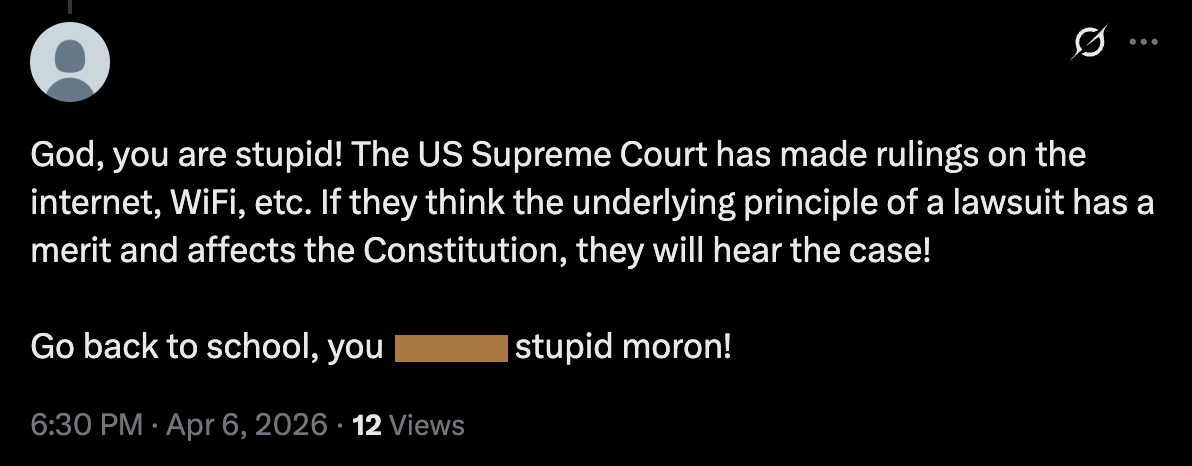
Such a person refuses to recognize that a court saying so does not change the Constitution. The Constitution is a binding legal contract between the States. It contains specific definitions of power delegated to the federal government, most of which establish a central organization (the federal government) as an external-facing entity intended to provide a unified approach to foreign relations. The courts can’t insert into the Constitution that which isn’t there.
That people expect the federal government to be involved in domestic affairs and solve our social ills is the reason government costs Americans so much, and also why it is so susceptible to financial corruption.
Government isn’t a service organization. Government should not be seen as or expected to be a service organization. Government is utterly incapable of providing any services at scale, and any time government is expected to do so, bureaucracy is put in place that becomes an end unto itself. Thus, that bureaucracy’s main purpose becomes self-preservation. It does not matter that it never solves the problem it was intended to address. It does not matter that it continues to grow and require more and more resources, both of a staffing and of a financial nature (and more staff means more finance). It is a black hole that sucks in tax dollars never to be seen again.
This is what Americans have not only come to accept, but it is what most Americans have come to expect. They want a government that will “do for the people what the people can’t do for themselves.” This also is absolutely contrary to everything for which the founding fathers stood and fought.
Government is not a charity. Madison stated so directly when he said, “Charity is no part of the legislative duty of the government.” Beyond this, along the lines of government and social issues, Madison, considered the “father of the Constitution,” also said, “I cannot undertake to lay my finger on that article of the Constitution which granted a right to Congress of expending, on objects of benevolence, the money of their constituents.”
Such sentiment is not restricted to Madison alone. Jefferson, who penned the Declaration of Independence stated, “Still one thing more, fellow citizens, a wise and frugal government, which shall restrain men from injuring one another, shall leave them otherwise free to regulate their own pursuits of industry and improvement, and shall not take from the mouth of labor the bread it has earned. This is the sum of good government; and this is necessary to close the circle of our felicities.”
The founders believed government in general to exist for the purpose of protecting and preserving our rights and our right to private property ownership. Everything the government does now is contrary to this purpose, and it costs us dearly. It costs us financially (look at the billions in fraud and trillions in debt America incurs each year) and it costs us in liberty, despite the federal government (allegedly) being established to preserve liberty: “We the People of the United States, in Order to…secure the Blessings of Liberty to ourselves and our Posterity, do ordain and establish this Constitution for the United States of America” (preamble to the U.S. Constitution).
Our federal government is no longer constitutional in any sense of the term, and our elected representatives don’t care. What’s more disturbing and detrimental, however, is that the vast majority of Americans don’t care either. It matters not to most that the federal government, which was (according to Madison in the Federalist No. 51) supposed to be smaller than any of the state governments, is now the largest employer in the country (and guess who foots that bill).
When we desire the government to provide anything other than protection of our rights and borders we end up with neither. The more we expect of government, the more it costs us of our wallets and our rights. Government is not our benefactor - it is a necessary evil. Again turning to Madison:
If Men were angels, no government would be necessary. If angels were to govern men, neither external nor internal controls on government would be necessary. In framing a government which is to be administered by men over men, the great difficulty lies in this: you must first enable the government to control the governed; and the next place, oblige it to control itself.
Men are not angels, and those who now end up in government are further from that status than most others. Government no longer controls itself; it is up to the people, as it always has been, to do so. This is the nature of a representative government that operates with delegated powers. Those powers are delegated by the people, and the more we voluntarily give up, the more government will take. The only way to end the cycle is to stop giving up our liberties in order to have government provide for us, and that requires Americans waking up to the fact that the government isn’t a service organization.
"Those who would give up essential Liberty, to purchase a little temporary Safety, deserve neither Liberty nor Safety." ~Benjamin Franklin
The 10th Amendment is the hinge upon which Federalism was supposed to operate in the newly formed United States of America. "The powers not delegated to the United States by the Constitution, nor prohibited by it to the States, are reserved to the States respectively, or to the people." The Federal powers should and must be constrained and all other interests vested in the power of the people in their respective states. Allowing our bureaucracy to balloon far past the boundaries imagined by the signers/framers of the Declaration of Independence and the Constitution Of the United States of America, has bastardized the very legitimacy of this nation as it now stands. And I honestly see no way back except through a hard reset and sweeping dismantling of 95% of ALL federal agencies, programs, and NGOs. Without it, there is no United States and we might as well dissolve this union and return to the Articles of Confederation. At least that way each state is the steward of their own destination not beholden to the politics of another state or an elite ruling class over an entire 50 state nationality. Make self-determination and self-governance great again! MSDSGGA doesn't have the same ring...lol!